When you think "olympic" the concept of "top of their game", or "monumental" comes to mind. While "Olympic" refers generally (and usually) to the Olympic Games, it is often used as a verb (no doubt much to the chagrin of Olympic Officials) to characterize the best. This year, when the Olympics arrives in London, it seems that USA Today is sending in the farm team rather than the best, when it comes to their photography staff, for the most part.
USA Today staff photographers with decades of experience covering sports were told last week that, well, their services wouldn't be needed in London. USA Today Sports Media Group Company, which now owns the US Presswire photo wire service, known to some as the "let's all work for photo credit, press-file hot dogs, and a few stock sales" photography operation, decided that they would choose the team going to cover the olympics this year, save for just one well regarded USA Today photographer. If there was any doubt that the staff will be wet behind the ears, you need look no further than the list of those credentialed - Richard Mackson's teenage kid seems to be credentialed as a part of the team of pros going over and she either just (or will soon) graduate from...wait for it... high school.
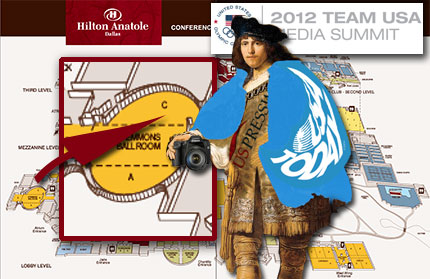
If you're looking to talk to the USA Today photo booth out at the Olympic Media Summit at the Hilton Anatole, going on today and tomorrow, they won't be there. Well, the booth is there - in Stemmons Ballroom C (on the right as you walk in), but it's not actually staffed by USA Today staffers - instead, it's staffed by US Presswire staff and contractors. So if you see someone wearing a USA Today credential, shirt, or beneath one of their banners, it's really a US Presswire person cloaked in the storied name of USA Today.
For decades, the USA Today photo staff has put forth the best of the best to cover the Olympics. So too has Sports Illustrated, and other storied organizations that see covering the Olympics as the pinnacle of sports photography. I am sure that Getty Images will be quite interested to know that US Presswire is parading around under the cloak of USA Today, seeing as the US Olympic Committee encourages people (
here) to contact Getty for rights-manged images, noting "In addition, Getty Images has a vast archive of U.S. Olympic-related images." In fact, according to the Getty website
here, they say "
...As the official photographic agency of the International Olympic Committee since 1988, we have the imagery you need to set your Olympics coverage apart." While I am sure that USA Today has shared content with their sister organization (Gannett) newspapers in the past, it doesn't take much to consider that Getty's revenues will be affected by US Presswire syndicating their content from the Olympics outside of USA Today and Gannett. Then again, maybe not. Maybe Getty is right - their coverage may well be "...set...apart.." and not even in the same league as USPWs. In this case, Getty is the big leagues, and, yes, coming full circle, the USA Today team, filled with USPW photographers, seems to be the farm team.
I'm guessing that the new President and Publisher of USA Today, who will be reporting to Gannett (NYSE:
GCI), Larry Kramer, (announced just today,
here) will be wondering why a teenager is on the credentials list along with so many other US Presswire photographers when his thoroughbred sports photographers didn't make the cut. According to the USA Today article, he's in charge of the USA Today Sports Media Group, so this issue falls right under his responsibilities list.
(Comments, if any, after the Jump)
Please post your comments by clicking the link below. If you've got questions, please pose them in our Photo Business Forum Flickr Group Discussion Threads.
 According to the NASDAQ website (here) the Financial Times is reporting that Goldman Sachs has been retained to consider an IPO and other options. Photo Business News reported that federal regulators had approved Hellman & Friedman taking Getty private (Getty Images - Moving Forward, 3/19/08) at a rate of $2.1B (according to Forbes) and $2.4B according to the Nasdaq site. They are considering a valuation for the IPO of $4B. Getty at one point saw highs of $90+ a share in their heyday, before plummeting and then going private. With the Shutterstock IPO revealing their average stock sale of $2.05 per image in an SEC filing (as reported by Photo District News, here), how can Getty see a $4B valuation? Dubious, at best.